







-399x408.jpg "Synthesizers")





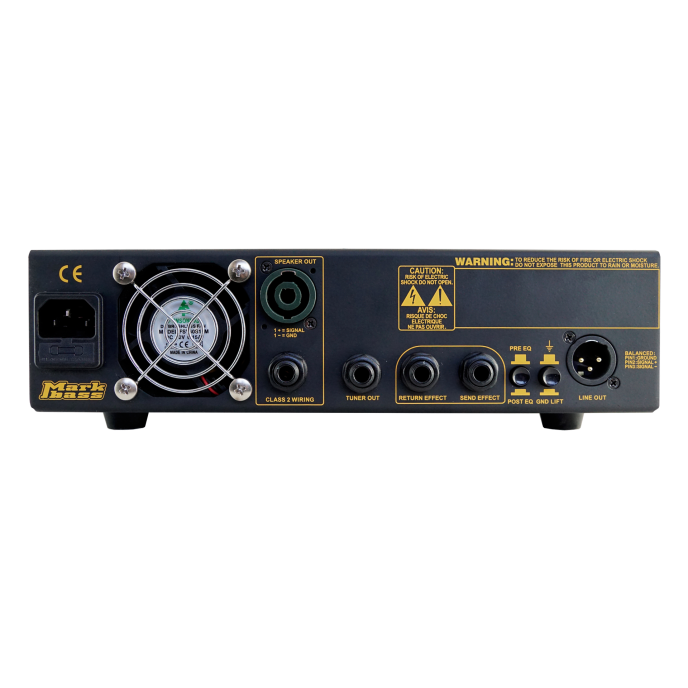
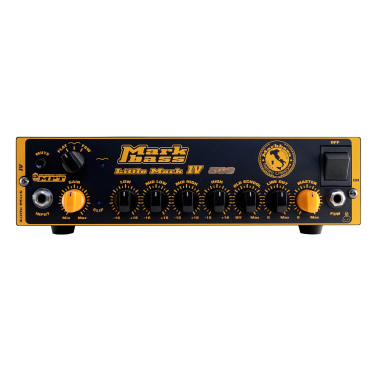
Markbass Little Mark IV 300
Warranty from the manufacturer: 12 months.
Description of the Markbass Little Mark IV 300
The moment you start hunting for “your” bass sound and work your way through different amps, it’s usually when your eyes land on the Markbass Little Mark IV 300 that you realise this is about compact size without compromise, full control over your tone, and a lively, full-bodied bass sound that you’ll want to hear in the rehearsal room, on stage and in the studio all at once.
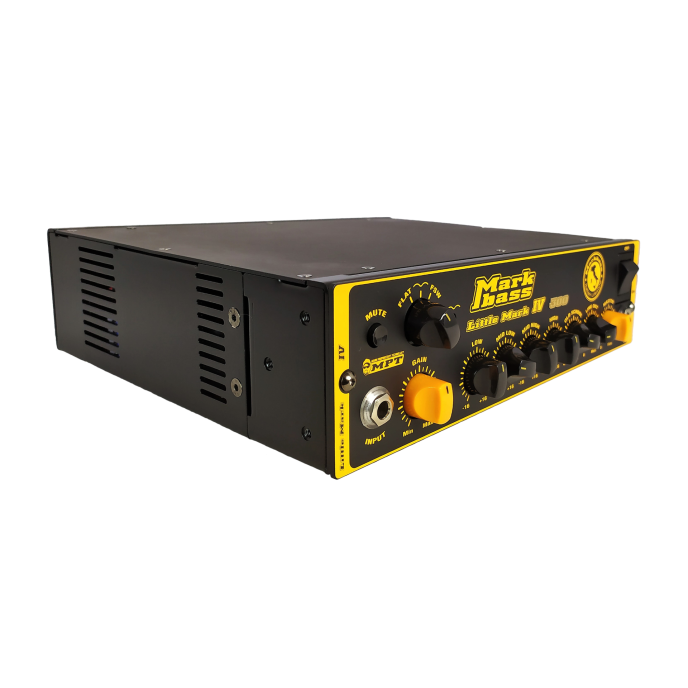
Straight away it’s nice to see that this isn’t some brick with a handle, but a lightweight, essentially universal head that slips easily into a rucksack or laptop bag. And those 300 watts at 4 ohms are good for far more than bedroom experiments. This kind of headroom comfortably covers club gigs, rehearsals with a drummer, studio sessions and even smaller festival stages, as long as there’s proper monitoring and a line to the desk. The amp doesn’t scare beginners off with a maze of controls, yet it still offers enough fine adjustment that a more experienced bassist won’t feel boxed in.
Why choose this model?
- Practical power in a lightweight chassis: delivers up to 300 watts at 4 ohms while weighing around 2 kg
- Signature Markbass voice with warm mids, clear attack and tight lows that sit comfortably in the mix
- Flexible EQ with musical frequency points and two intelligent filters, letting you quickly adapt your sound to any room or venue
- High-quality DI output for connecting to a mixing desk, studio interface or live rig without noise or nasty surprises
- Thoughtfully laid-out connections, efficient cooling and solid build quality designed for regular rehearsals and constant gigging
Model overview
Inside the Markbass Little Mark IV 300 you’ll find a modern Class D power amp paired with a solid-state preamp. In practice that means consistent volume, fast transient response, and minimal weight. The full 300 watts are delivered into a 4-ohm load. Hook up an 8-ohm cab and you get roughly 150 watts, which is still more than enough for rehearsals, smaller shows and studio work where the main sound is taken from the line output anyway.
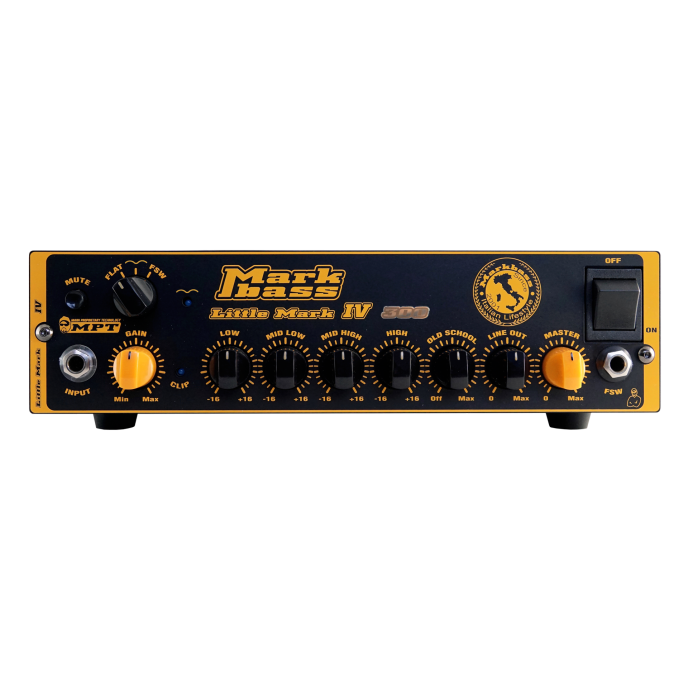
The front panel is laid out logically. First there’s the input for your bass, with a nearby sensitivity switch for active and passive instruments. That makes life easier if you own basses with different output levels. Next comes the input level control, helping you avoid overdriving the preamp. After that you’ve got a four-band EQ. Separate controls for bass, low mid, high mid and treble frequencies let you really fine-tune your tone. There’s no sense that the EQ is crude or kills your dynamics; on the contrary, the range feels very musical.
The signature filters are a real highlight. The first one softens the attack and gently rolls off the top end. It’s ideal for fingerstyle and more old-school flavours. The second filter lifts the highs more noticeably and trims a touch of low end. That setting works brilliantly for slap, quick runs and tighter rock parts where the bass has to cut through guitars and drums. These filters don’t distort the natural character of your instrument; they function more like a tasteful bonus that helps you adapt to whatever situation you’re in.
The master volume sits on its own and governs overall loudness without affecting the line output. That’s handy when you want to keep a consistent level going to the desk but change how loud things are on stage or in the room. On the rear panel you’ll find a balanced XLR DI out. You can usually choose pre or post EQ and switch the ground lift. This gives the engineer a clean, predictable signal without hum. That matters not only on big stages but just as much when recording at home via an audio interface.
Speaker outputs are provided as Speakon or combination sockets, making cable choice straightforward. The amp is happy driving loads from 4 to 8 ohms, so you can run a single 4-ohm cab or a pair of 8-ohm cabinets. That makes it easy to expand your rig over time. Start with one compact cab, then add a second later if louder projects appear on the horizon.
Despite its small footprint, the cooling system inside is very effective. The fan cuts in only when needed and generally runs quietly enough not to intrude in a studio setting. The chassis itself is robust, with a metal frame and well-thought-out protection features. This is a piece of kit built to withstand frequent transport, the odd knock in a gig bag and regular stage use. Treat it sensibly and it will serve you reliably for years.
Who is this model for?
This amp will appeal to bassists who want one do-it-all head for every situation, but don’t fancy hauling around a heavy valve rig. The Markbass Little Mark IV 300 slots neatly into the life of a developing player who wants a confident, “grown-up” bass sound without endless menus and hidden sub-menus. Drop it on top of a cab, plug in, bring up the master, tweak the EQ and filters a touch, and you’re ready for gigs or band rehearsals.
Self-taught players will find it a great platform for experimenting with tone without having to understand complex rack systems. It’s forgiving of minor level mistakes, behaves predictably and responds honestly to your playing. Hobbyists who keep music as a passion on the side will love the portability. You can take it to a cottage, a friend’s studio or a small venue with minimal hassle. At the same time it never feels like a toy and clearly reveals all the nuances of your technique.
For professional bassists, stability, DI quality and the ability to dial in a sound quickly for any room are key – and that’s exactly what you get here. If needed, the amp can serve as a personal monitor while the main signal goes to the PA. Session players and producers will appreciate its consistent behaviour in different environments, low noise floor and precise frequency control. Engineers will welcome a clear, defined signal that sits in a dense mix without hours of corrective EQ.
For composers and arrangers, it’s a practical day-to-day tool. You can plug your bass into the amp, send the DI to your interface and at the same time listen through a cab. That makes it easier to shape parts and check how the bass feels in tracks across genres, from funk and pop-rock to metal or indie. The amp doesn’t push you towards any particular style. It faithfully conveys the character of your instrument and leaves it up to you whether the sound should be warm and rounded or fast and aggressive.
Specifications of the Markbass Little Mark IV 300
- Type: solid-state bass head with Class D power amp
- Output power: 300 W at 4 ohms, approximately 150 W at 8 ohms
- Preamp: solid-state with input level control and switch for active/passive basses
- EQ: four-band, with separate controls for bass, low mid, high mid and treble
- Additional filters: two proprietary filters for quickly reshaping your overall sound character
- Master output: dedicated master volume control
- Inputs: instrument input for bass guitar
- Line output: balanced XLR DI out with pre/post EQ selection
- Speaker connections: cabinet outputs supporting loads from 4 to 8 ohms
- Cooling: active cooling with automatically controlled fan
- Intended use: rehearsals, club gigs, studio sessions, home practice
- Dimensions: compact mini-head format, easy to transport
- Weight: approximately 2 kg, light enough to carry in a rucksack or bag