



-399x408.jpg "Synthesizers")

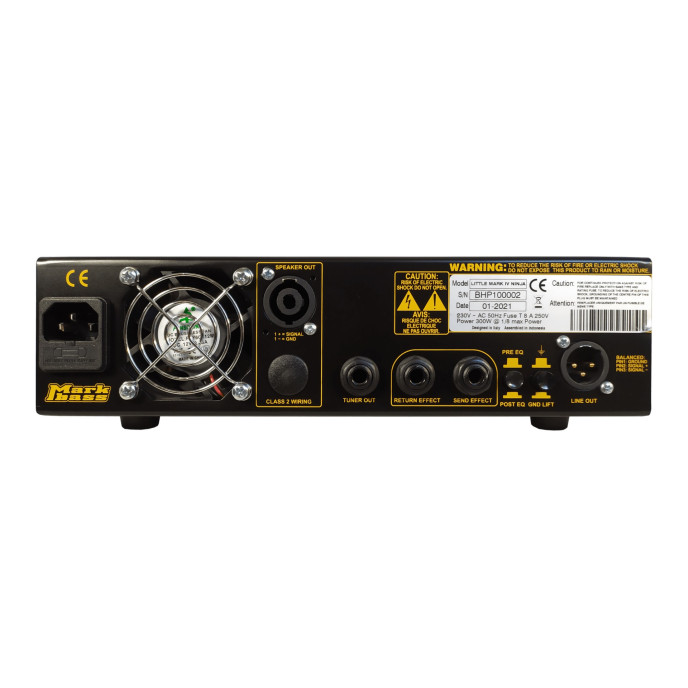
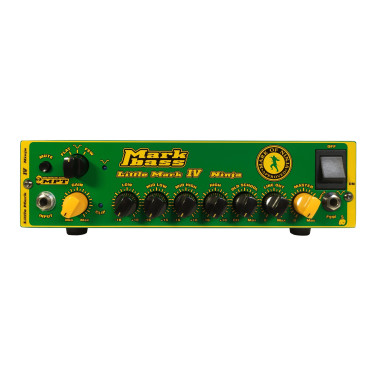
Markbass Little Mark IV Ninja
Warranty from the manufacturer: 12 months.
Description of the Markbass Little Mark IV Ninja
The moment you get your hands on a proper bass amp, you realise just how much sound affects your inspiration – and that’s exactly where the Markbass Little Mark IV Ninja gives you the confidence boost you need, whether you’re at rehearsal or playing an important gig.
The first impression is almost always the same: a small, lightweight box that, in terms of sound and headroom, feels like a serious, full-scale unit that can easily handle both club sets and studio sessions.
Overall impression and purpose
This is one of those amps you can throw in a single bag, jump on the tube or into a taxi and not worry about your back.
The Italian designers focused on compactness without stripping away features, and the result is an amp that covers the vast majority of typical bass player needs.
It delivers a transparent tone, that signature mid punch, solid low end and, at the same time, enough definition to cut through even dense arrangements.
Whether you’re practising at home, playing in a band or already stepping onto professional stages, you won’t find yourself hitting a ceiling in terms of what this head can do.
The amp pairs well with a wide variety of basses and cabinets.
You can plug in a vintage passive Jazz, then swap to a modern active five‑string, and in both cases get a distinct but easily controllable character.
The controls are laid out so intuitively that you can dial in a solid working tone purely by ear, without endless tweaking.
That’s a huge help when you’ve got almost no time for soundcheck before a show but still need a stable, predictable sound in your monitors and out front.
Why choose this model?
- High output power in a very compact and lightweight chassis – easy to take to rehearsals and gigs
- Versatile tonal character: from clean, modern sounds to tight, punchy rock tones without harsh top end
- User‑friendly EQ with a clear logic, plus the signature VLE and VPF filters that let you quickly reshape your sound
- High‑quality DI with pre/post switch and ground lift – especially valuable for live shows and studio recording
- Reliable build, well‑designed cooling and stable operation even under long, loud sets
Model overview
At the heart of the Markbass Little Mark IV Ninja is a powerful Class D power section paired with a solid‑state preamp.
This design keeps the amp light while providing a serious amount of wattage – more than enough for rehearsals with a drummer and for club gigs.
When needed, you can hook the head up to an efficient, high‑sensitivity cab and get a genuinely loud, articulate rig without pushing it into unwanted clipping.
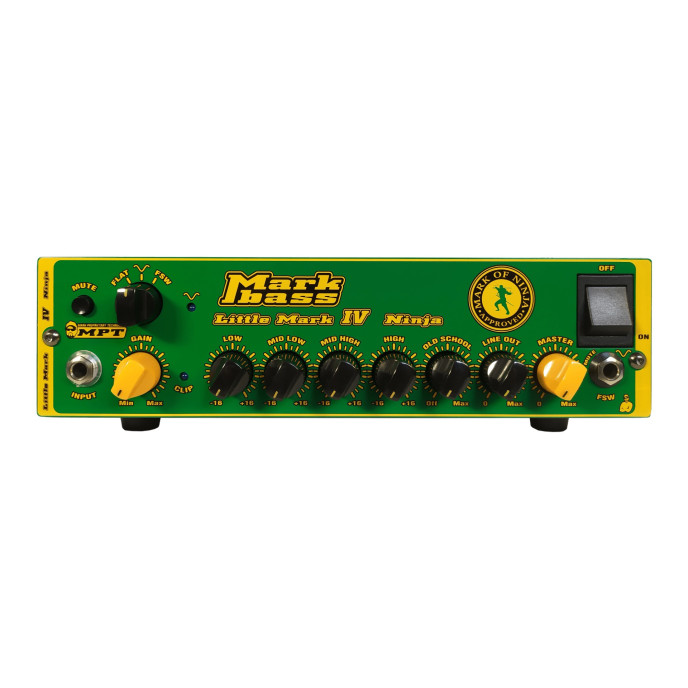
The front panel layout is straightforward and logical.
There’s an instrument input with Gain control, a clip LED, a main Master volume and the EQ section.
The four‑band EQ uses fixed frequencies chosen for real‑world bass needs rather than textbook curves.
The Bass control lets you add foundation without boom, the low‑mid shapes body and definition in the mix, the high‑mid helps bring out attack and presence in the arrangement, and the Treble adds air and clarity.
Used sensibly, these four knobs cover a very wide range of tonal requirements.
Then you’ve got the dedicated VLE and VPF signature filters.
VLE gently rolls off the top end, giving a more vintage flavour reminiscent of old valve stacks and speakers with a limited frequency range.
VPF applies a smooth “smile” EQ curve, boosting lows and highs while slightly scooping the mids.
This produces a more modern sound that’s ideal for slap, fusion, or simply a thick, “fat” tone in pop and rock arrangements.
Crucially, these filters don’t make the tone sound artificial – they just emphasise the right details, and you can use them very subtly, like a seasoning.
On the rear panel you’ll find all the essential connections: speaker out that supports low‑impedance loads, a balanced XLR DI, a line out and a socket for a tuner or external devices.
The DI can be switched pre or post EQ, which is convenient both for the sound engineer and for you.
Some players prefer sending a completely “clean” signal to the desk and shaping the tone on stage or in the studio, while others want front‑of‑house to receive exactly the sound they hear in their own cab.
The ground lift helps eliminate potential ground loops and hum in more complex setups.
In real‑world use, this head proves to be extremely flexible.
At home you can keep the volume very low, still get a clear, musical tone and avoid choking the bass.
In rehearsal you simply raise the Master, tweak the EQ a bit for the room and cut through drums and guitars with ease.
On stage you add to this a quality DI that gives the engineer a ready‑to‑use signal, while you retain control over what goes to your cabinet and monitors.
Who is this model for?
This amp feels equally at home with a beginner just getting to grips with the instrument and with a seasoned player who needs a reliable, predictable workhorse.
If you’re learning at home, you won’t have to put up with a huge, heavy “wardrobe” of an amp or sacrifice half your living space.
Its compact size means you can easily place the head on a desk, a small stand or directly on the cab in a modest‑sized room, and the intuitive controls make it easier to understand how EQ works and what each knob actually does.
This way you’re not only learning to play, but also training your ear to hear how the tone changes with different settings – an essential skill for any musician.
For players already rehearsing with a band, the amp delivers the kind of versatility that many search for over years.
You can take it into any studio, hook it up to whatever cab is available and still get a familiar sound, without relying on whatever random gear happens to be in the room.
If you play in multiple projects – from cover bands to original material – a quick EQ tweak and slight adjustment of the filters is all it takes to fit the genre.
In a single evening you can genuinely travel from smooth funk to aggressive metal just by changing the head’s settings and the attack of your right hand.
For sound engineers and producers, this model is a dependable, predictable source of bass tone for live sessions.
You can take a signal from both the DI and a mic’d cab, blend them and get a rich texture without nasty surprises.
Noise levels stay low and the dynamics remain intact.
For session players and touring musicians, that reliability is especially valuable: you arrive at a venue, power up the amp and know it will behave exactly as it did at last night’s show or the previous rehearsal.
It’s also worth mentioning those who’ve been playing for years but keep an amp at home purely for their own enjoyment.
In that situation, you don’t want a unit that takes up half the flat, weighs as much as a small fridge and puts you off picking up the bass.
Here, the combination of size, power and tonal flexibility actually encourages you to play more, to experiment with pedals, effects and different basses.
And if you ever decide to play your first live gig, you can confidently walk on stage with the same head – all you’ll need to add is a suitable cabinet.
Specifications of the Markbass Little Mark IV Ninja
- Amp type: solid‑state preamp, Class D power stage
- Output power: up to 1000 W at 4 Ohms
- Output power at 8 Ohms: up to 600 W
- Frequency response: approximately 20 Hz – 20 kHz
- Input: 1 x 6.3 mm bass guitar input with sensitivity (Gain) control
- EQ: four‑band, with individual controls for Bass, Low Mid, High Mid and Treble
- Signature filters: VLE (Vintage Loudspeaker Emulator) and VPF (Variable Pre‑shape Filter) with smooth adjustment
- Speaker outputs: Speakon/Jack combo, supports 4 or 8 Ohm loads
- DI output: balanced XLR with pre/post EQ switch and ground lift
- Additional sockets: 6.3 mm tuner/line out, line output, IEC mains inlet
- Cooling system: active, temperature‑controlled fan
- Indicators: clip LED, power status LEDs
- Power: mains, supports standard voltage ranges (varies by regional version)
- Dimensions: approximately 27 x 25 x 8 cm
- Weight: around 2.4 kg
- Design origin: Italy
- Typical use: home practice, rehearsals, club gigs, studio and live recording