






-399x408.jpg "Synthesizers")




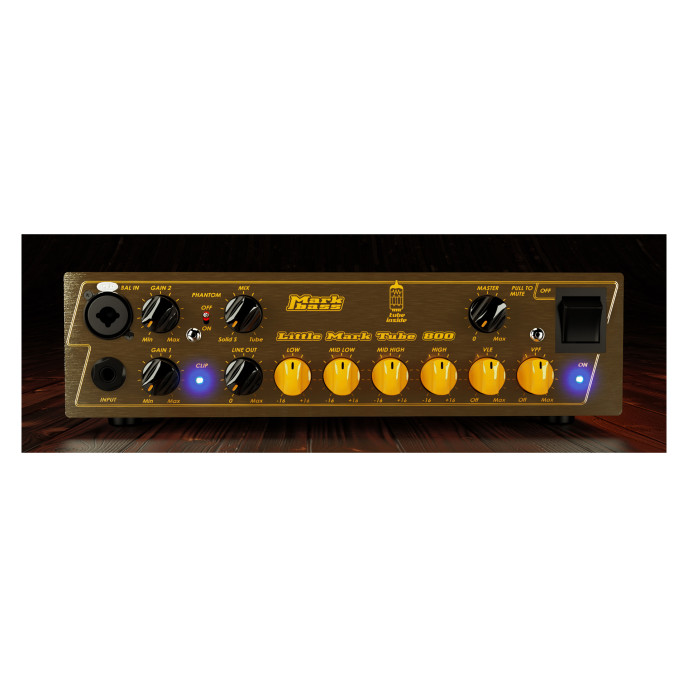
Markbass Little Mark Tube 800
Warranty from the manufacturer: 12 months.
Description of the Markbass Little Mark Tube 800
If you’ve been wanting your bass to sound powerful and musical without your Markbass Little Mark Tube 800 turning your rig into a back-breaking wardrobe, this head sits exactly in that category of gear that quietly changes your rehearsals, your gigs, and the way you feel about your own sound.
In terms of feel: this is one of those amps you bring into the rehearsal room, plug in your favourite bass, tweak the EQ a touch, and instantly realise you’re ready for both a small club and a big stage, without worrying about headroom or note definition. It’s compact and lightweight, yet genuinely loud, and when it’s dialled in properly it stays controlled even when you push it hard.
The key feature of this head is that it offers both valve colour and clean solid-state tone, and you decide the blend. That’s a huge bonus if you don’t want to lug around a massive all-tube beast but still love a living, breathing sound and a softer attack. In practice, this amp covers several roles at once: rehearsal, gigging and studio tool that can handle pretty much any style of bass playing — from funk and pop through to heavy rock and alternative.
Why choose this model?
- Lightweight, compact chassis that’s easy to carry in a backpack, so transport is never a headache
- Serious power reserve: 800 W at 4 Ohms gives you confidence you’ll be heard on any stage
- Blendable valve and solid-state preamp sections provide a wide range of tones, from crystal clean to gritty, crunchy drive
- Intuitive EQ with signature VLE and VPF filters lets you quickly tune your sound to the room or the style
- Built-in DI output with pre/post switch makes the amp equally at home on live stages and in the studio
Model overview
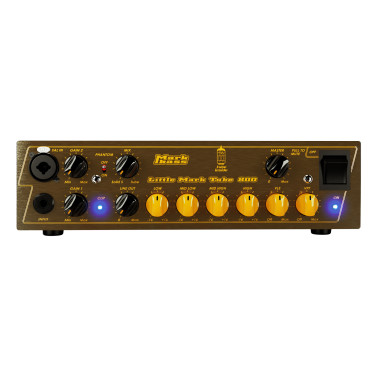
The sound of the Markbass Little Mark Tube 800 is built around a hybrid preamp that houses a 12AX7 valve and a solid-state circuit in one unit. On the front panel there’s a control that lets you smoothly blend between these two tonal flavours. Turn towards the valve side and you get richer mids, a softer top end and a hint of attack compression. Turn towards the solid-state side and the sound becomes more direct and immediate, with a tight punch and excellent clarity on busy lines.
You’re not locked into one character; you can tailor the head to different basses and different jobs. One day you’re playing soul on an active Jazz, the next you grab a five-string with a humbucker and hit a thick rock tone. No amp swapping — just a couple of tweaks on the blend and EQ.
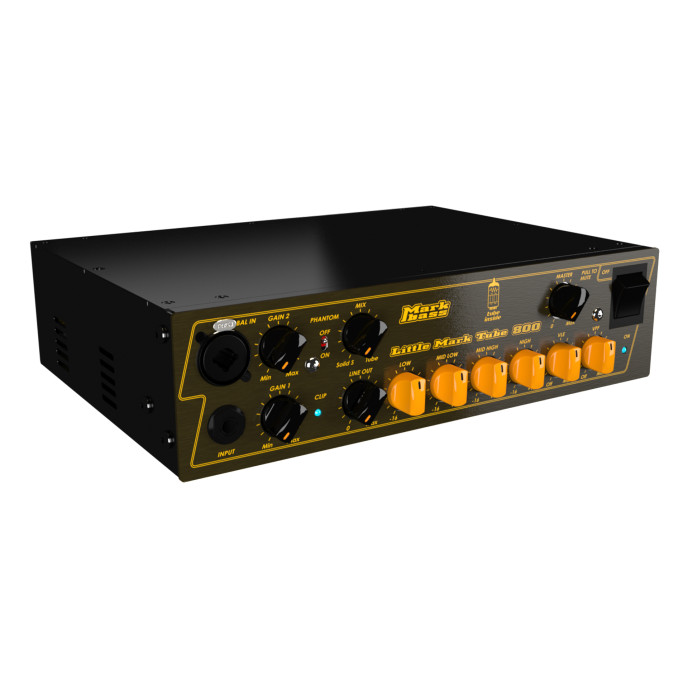
The EQ is four-band, with separate controls for lows, low mids, high mids and highs. The frequency ranges are chosen to match real-world bass needs. Need to tame stage boom? Gently trim the low band or the low mid control. Struggling to cut through the mix? Lift the high mids and add a bit of the VPF filter. Getting too much string noise or finger clatter? Soften it with the VLE filter, which emulates a more vintage, darker cabinet character.
Those two signature filters really streamline your workflow because they let you quickly shape the sound you hear in your head. You can go for a big, old-school tone in the vein of classic recordings, dial in a tight, modern sound for techno or pop, or land on a versatile middle ground for cover work. Many players love this head precisely because it doesn’t force one signature voice on you — it just gives you a very usable toolkit.
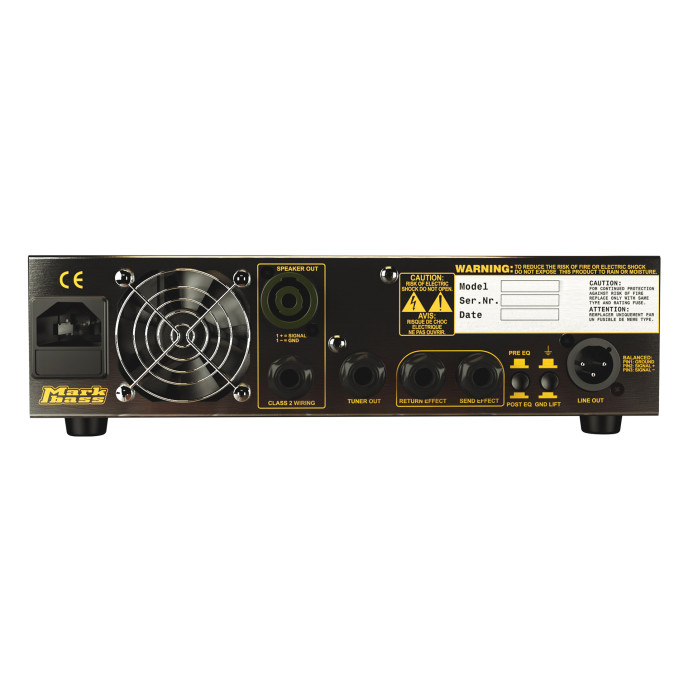
Connectivity is just as well thought-out. On the back panel you’ll find a Speakon speaker output and a combined Speakon/Jack socket, which is handy when you’re using different cabs. Minimum load is 4 Ohms, where the head delivers full power. That lets you comfortably drive large cabinets or a pair of smaller ones. There’s a DI output with Pre/Post option, so you can decide whether the engineer gets your already-shaped sound or a clean signal straight from the instrument. This is useful both live and in the studio: you can record a clean track while also mic’ing the cab or taking the processed signal.
The amp uses a switch-mode power supply, which is what keeps the weight right down. At the same time it has enough current headroom that even at high volumes the low end stays solid and controlled rather than falling apart. Cooling is well designed, so the head behaves reliably on hot stages, in sweaty clubs and in cramped rehearsal rooms.
The front panel is worth a separate mention. All the controls are laid out logically, and the knobs are large enough to use comfortably in a dark club. There’s clear level indication, an input pad for instruments with hot output, and a master volume that lets you set overall level without sudden jumps. That’s important when you’re working with different bands and venues and don’t want to waste time wrestling with gain staging.
Who is this model for?
You simply pick your core sound character, nudge the EQ, and you’re rewarded with a lively, inspiring tone. If you’re just starting out on bass, the Markbass Little Mark Tube 800 helps you avoid getting buried in endless settings so you can concentrate on playing. No tedious fight with mud or weird frequencies you have to hide with pedals. It’s a strong starting point if you want to hear a proper, satisfying result straight away and learn how your instrument reacts to dynamics.
For self-taught players and those for whom bass is a hobby, this head gives you the feeling that your sound has grown beyond basic home practice level. You can head out to jams, cover band rehearsals and first gigs without relying on old, tired combo amps in the room. Throw the head in a gig bag, turn up, plug into whatever local cab is there — and your sound is stable and familiar. That takes a lot of the stress out of playing live and makes you want to gig more often.
Professional bassists will appreciate the hybrid preamp and the ample volume on tap. You can comfortably work with different artists, genres and venues. Need a tight, modern tone for a pop act? Lean on the solid-state side and make use of the VPF filter. Want a warm sound for neo-soul or jazz? Blend in more valve and roll off some top with the VLE. The head adapts well to different cabinets and holds the low end together even with five- and six-string basses.
Engineers and producers will like the fact that it delivers a smooth, predictable DI signal, while also allowing you to capture a harmonically rich sound from a cabinet. You can build layered bass parts, combine a clean solid-state track with a valve-flavoured one, and use different degrees of colour within a single song. Noise levels stay low, so the recorded material sits neatly in the mix without endless cleanup.
Session players benefit from the combination of portability and versatility. When your calendar includes club gigs, studio dates and corporate shows with different artists, it’s vital to have a head that can take any brief in its stride. The weight is modest, but the feature set is that of a fully-fledged workhorse standard — easy to get used to and highly reliable on important shows.
Specifications of the Markbass Little Mark Tube 800
- Type: hybrid bass amp head (valve/solid-state preamp, class D solid-state power amp)
- Output power: 800 W at 4 Ohms, 500 W at 8 Ohms
- Preamp valve: 1 x 12AX7
- Blend control: seamless balance between valve and solid-state preamp channels
- EQ: 4-band (Low, Low Mid, High Mid, High)
- Filters: VLE (Vintage Loudspeaker Emulator), VPF (Variable Pre-shape Filter)
- Inputs: 1 x 6.3 mm Jack instrument input (with PAD switch for active basses)
- Speaker outputs: 2 x Speakon (one combined Speakon/Jack, one Speakon)
- DI output: balanced XLR, Pre/Post EQ switch, Ground Lift
- Line output: 6.3 mm Jack
- Controls: Gain, Tube/Solid State Mix, Master, Low, Low Mid, High Mid, High, VLE, VPF
- Power supply: switch-mode PSU, mains voltage depending on region (typically 230 V in Europe)
- Cooling: active, with fan
- Chassis: metal enclosure with protective corners, front control panel
- Dimensions: approximately 27 x 25 x 8 cm (width x depth x height)
- Weight: around 3 kg
- Country of design: Italy (manufacturer Markbass)
- Application: rehearsals, club and stage gigs, studio recording, work with DI and cabinets